Geography of Bhutan
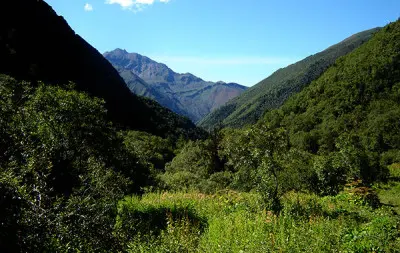
Bhutan is a landlocked country bordered by China to the north and by India to the east, west and south. The country’s landscape consists of a succession of lofty and rugged mountain ranges separated by deep valleys. Thick forests cover most of the slopes. Several rivers flow southward into the Brahmaputra River in India.
The snow-capped mountains in the north reach a height of over 7500 meters above sea level. The northern belt is home to a few nomads and yak herders, who move to warmer places in winter and bring their livestock back to graze in summer. The snow-fed rivers in the alpine region provide pastures for the livestock in the summer.
In the inner Himalayas, the elevation ranges from 1,500 to 3,500 metres. Major towns such as Thimphu, Paro and Punakha lie in this zone. During the monsoon, from June to September, the valleys become lush and green.
In the south, the Southern Hills are covered with dense deciduous forest, alluvial lowland river valleys, and mountains that reach around 1,500 meters above sea level. The northern edge of the southern foothills has dense vegetation and abundant wildlife. The border towns all lie in the southern foothills, along the border with India.
The climate is humid and subtropical in the southern plains and foothills, temperate in the inner Himalayan valleys of the southern and central regions, and cold in the north, with year-round snow on the main Himalayan summits.